Architectural
Wyckoff Centennial Monument
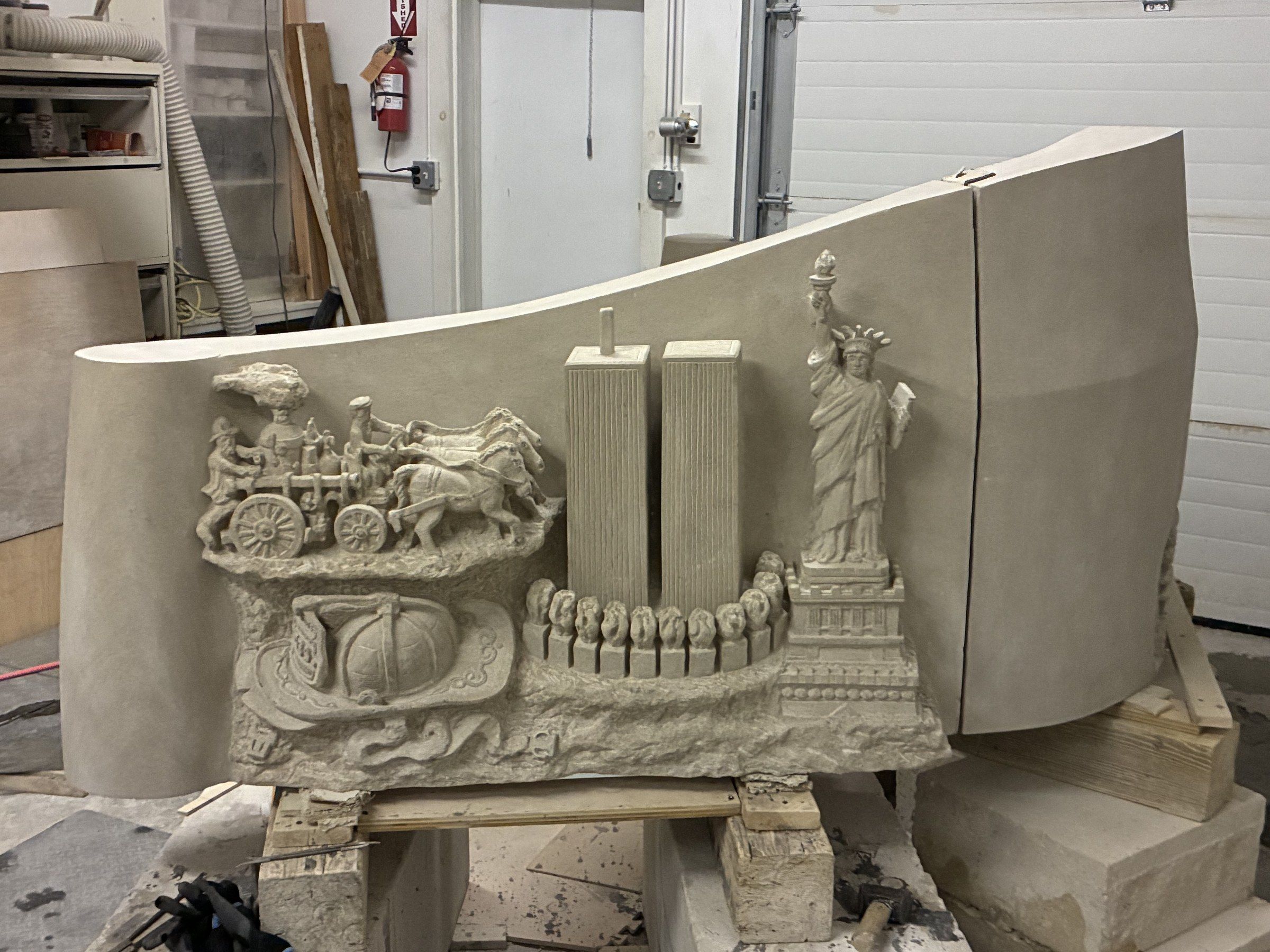
A three-block limestone monument carved by hand over thirteen months in Jean-Claude Marchionni's Midland Park studio, commissioned by the Township of Wyckoff. Now in place at the foot of Memorial Town Hall, it remains under wraps until its unveiling on November 7, 2026, for Wyckoff's centennial, America's 250th anniversary, and the 25th anniversary of September 11.
- Year
- 2026
- Location
- Memorial Town Hall, Wyckoff, NJ
- Material
- Limestone
- Client
- Township of Wyckoff
This piece, Jean-Claude Marchionni’s most ambitious commission of the past decade, took shape over thirteen months in his Midland Park studio — from the first sketches drawn on the workshop floor on October 3, 2025, to its installation at the end of October 2026. Commissioned by the Township of Wyckoff, New Jersey, at the mayor’s initiative, it is now in place at the foot of Memorial Town Hall, 340 Franklin Avenue, and remains under wraps until its unveiling and dedication on Saturday, November 7, 2026.
It marks three anniversaries at once: Wyckoff’s centennial (1926–2026), the 250th anniversary of the United States, and the twenty-fifth anniversary of September 11, 2001.
It is not a single stone but an assembly of three carved limestone blocks: a tall central panel flanked by two curved wings that recede in opposing volutes, drawn together into a single flowing form — a wave, or a drapery held open. Carved in high relief on both sides, it is meant to be walked around, not merely faced.
One side holds the memory of September 11. A nineteenth-century horse-drawn fire engine races forward at the left — a tribute to the long lineage of New York’s firefighters, from the volunteer brigades of the 1800s to those who answered the call on that September morning. At its base rests a fireman’s helmet draped with the American flag, in honor of the Wyckoff firefighter who died that day. At the centre rise the Twin Towers, straight and unbroken, as they stood for twenty-eight years above lower Manhattan. At their feet stand eleven forms, half flame and half flower — one for each of the eleven Wyckoff residents who died in the towers on September 11, 2001. On the right, the Statue of Liberty lifts her torch — the republic’s long answer to the day’s wound.
The other side holds the town’s own memory. The Zabriskie House, the colonial Dutch house that also appears on the township’s coat of arms; the Wyckoff Reformed Church with its clock tower; and a bearded figure at work — Jean-Claude Marchionni himself, the sculptor. Above them, the town that same morning, under a sky that is slowly darkening. A single star rises above the steeple; the smoke of distant Manhattan reaches the edge of the horizon. Life continues; the shock is just beginning to arrive.
At the summit of the central panel, the words “IN GOD WE TRUST” are carved above a medallion of the Tree of Life — roots and branches enclosed in a ring, the oldest emblem of memory and renewal. On the opposing panel, “UNITED STATES OF AMERICA 1776” rises above a medallion of oak leaves, for the nation’s 250th year. The township’s own coat of arms — “TOWNSHIP OF WYCKOFF ★ NEW JERSEY 1926” — is carved on a separate stone and set at the monument’s foot, for its centennial.
On the reverse of the central panel, cut by hand with the same chisel that carved every figure, is the maker’s mark: “J.C. Marchionni — Design & Sculpture — 2026”. No digital modelling, no shortcut. Thirteen months of stone dust, of marks laid down and taken back, of a composition built up section by section until the three blocks became one. Eleven residents of Wyckoff died in the towers that September; this stone will stand in their memory, and in the town’s, for as long as stone can stand.